

REQUEST A DEMO
Thank you! Your submission has been received!
Oops! Something went wrong while submitting the form.
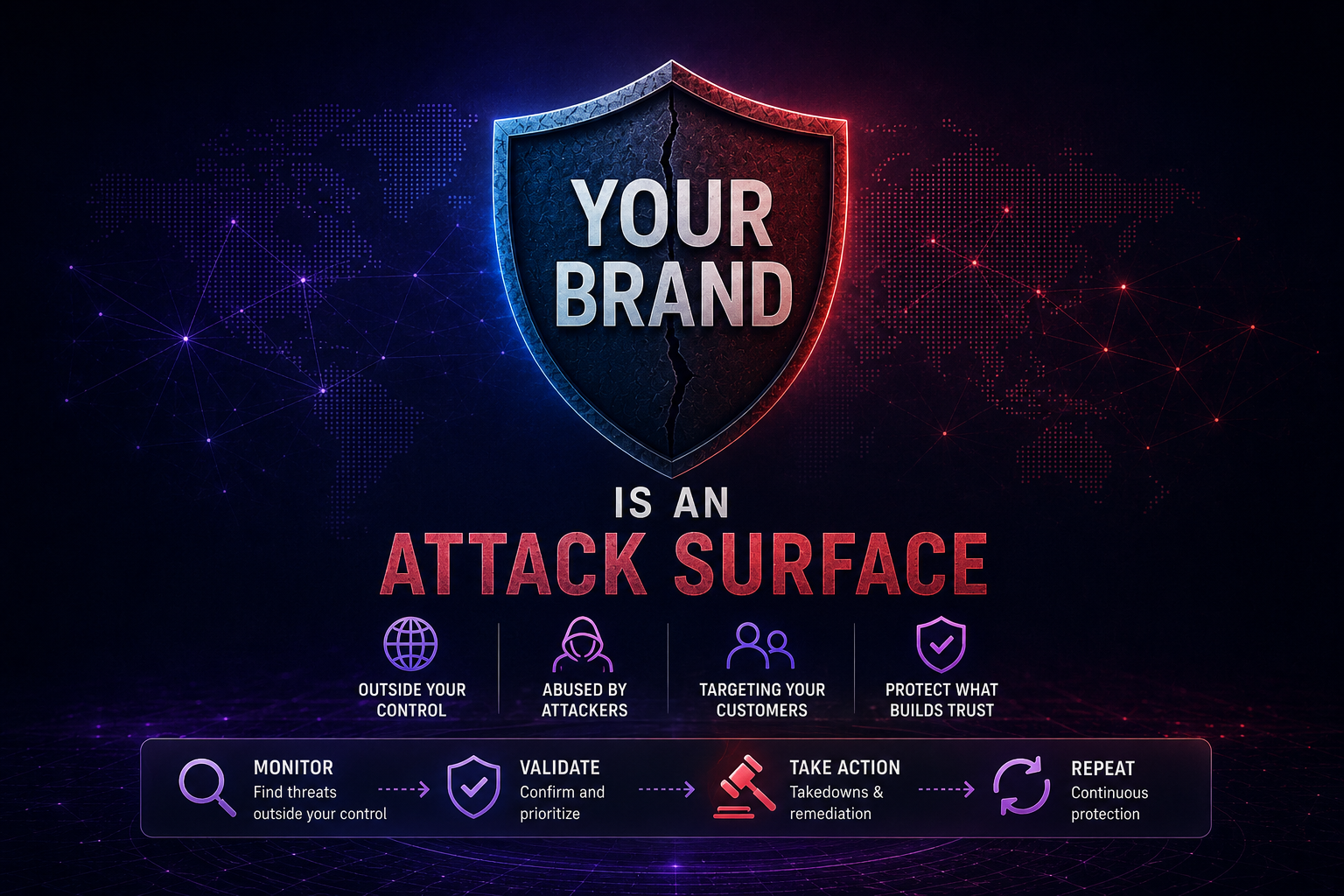
Most security programs are built around the assets an organization owns and controls: its infrastructure, applications, users, data, and operating environments. That remains essential, but it is no longer sufficient. A growing share of the damage done to companies in 2026 never touches those environments at all. It happens in your name, to your customers, on infrastructure you do not control and cannot patch.
This is the domain of digital risk protection, and it is the part of the threat landscape most security programs are still treating as someone else's job.
Consider how brand impersonation actually works. An attacker registers a domain that looks like yours. They clone your login page, often in under a minute using a phishing kit that handles the replication automatically. They send it to your customers, your employees, or your partners. Credentials get harvested. Money moves. Reputation erodes.
At no point did the attacker breach your systems. There are no stolen credentials of yours, no compromised inbox, no malware on your servers. Your internal security stack sees nothing because there is nothing inside to see. The first signal you get is often a customer complaint, by which point the fraud has already worked.
Microsoft has remained the most impersonated brand in phishing through early 2026, with the most-abused brands concentrated around the platforms people use to log in and pay. The reason is simple: attackers borrow the trust a recognized name has already earned. The more your customers trust you, the more useful your brand is to someone willing to wear it.
The difficulty is not detection. A newly registered lookalike domain is not a subtle artifact. The difficulty is that these threats live outside the places your security tools are pointed, and they multiply faster than a human team can chase them. Phishing infrastructure churns constantly, with domains spun up, used, and abandoned on short cycles specifically to outpace takedowns.
Defending against this requires a different posture than perimeter security. You have to monitor the open web, social platforms, app stores, and the dark web for abuse of your brand, your domains, and your executives. You have to confirm what's malicious, gather evidence, and drive takedowns to completion. And you have to do it continuously, because the moment one fake domain comes down, the infrastructure to stand up the next one already exists.
The instinct is to treat this as a standalone product, a brand monitoring subscription bolted onto everything else. That recreates the problem most security teams already have: another dashboard, another feed, another set of alerts disconnected from the rest of the picture.
Digital risk protection is most useful when it is connected to the rest of your intelligence program. A lookalike domain means more when you can see whether the same actor is also selling access to your sector on a dark web forum, whether your executives' credentials are circulating in stealer logs, and whether the infrastructure being used overlaps with campaigns hitting your peers. The external signal and the internal program belong in the same view.
This is the logic behind how Threatnote handles digital risk protection. Brand and domain monitoring, dark web coverage, and takedown workflows are not separate products stitched together by an analyst. They sit inside the same platform as the intelligence program they inform, so a detection outside the perimeter connects to everything you already know about the actors targeting you.
The companies adjusting to this stop drawing a hard line between "our security" and "things happening on the internet with our name on them." The brand is an attack surface. It is exposed, it is targeted, and it deserves the same continuous monitoring and response you already give your endpoints. Treating it as a marketing concern, or as nobody's job, is how the customer complaint becomes the first alert.