

REQUEST A DEMO
Thank you! Your submission has been received!
Oops! Something went wrong while submitting the form.
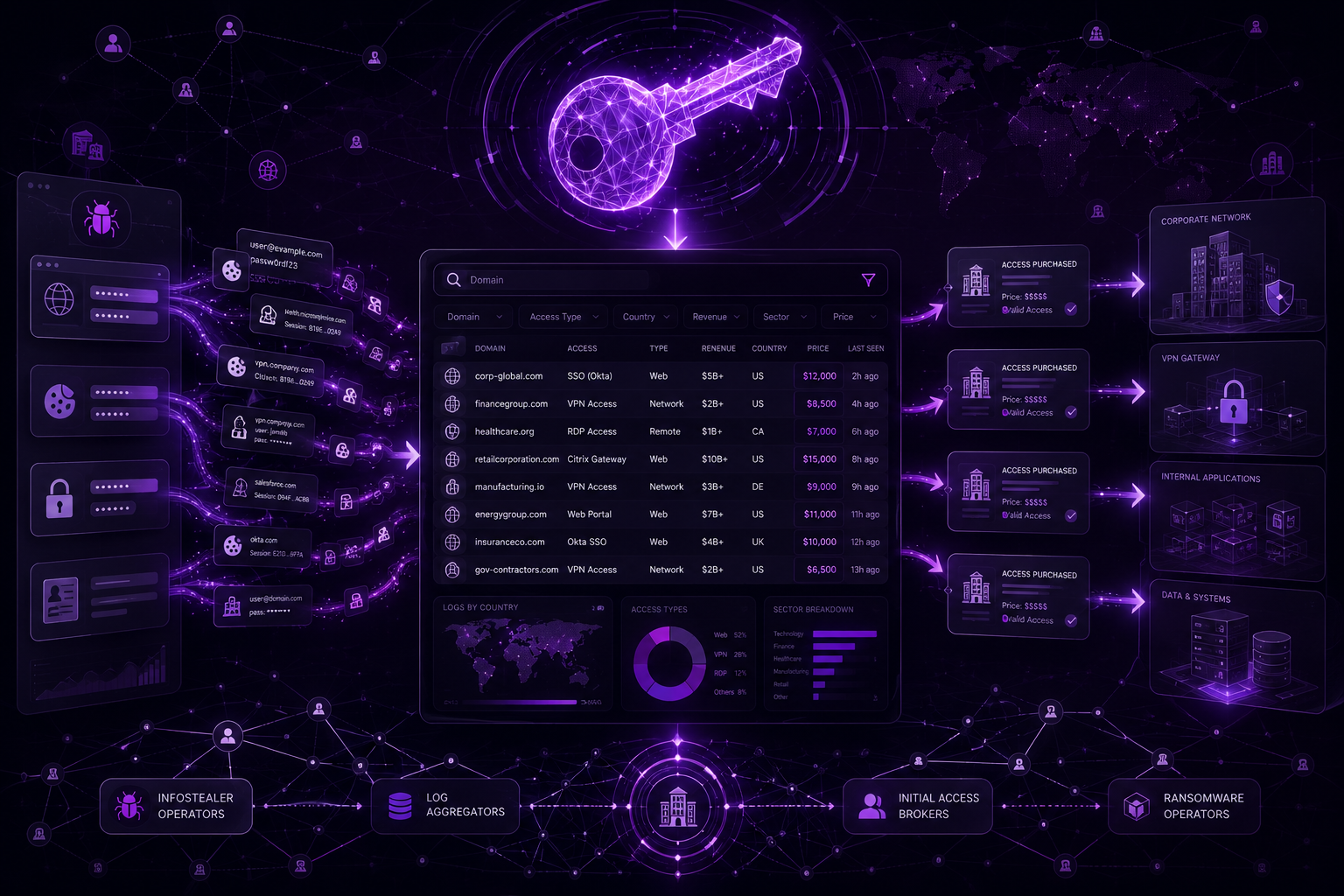
Most people picture a breach as a single dramatic moment. A wall goes down, an attacker rushes in, data pours out. The reality is more boring and more industrial. By the time a ransomware crew is inside your environment, the access they are using was very likely bought, not earned. Someone else did the breaking in. The crew just paid for the key.
This is the credential economy, and understanding it is the difference between reacting to breaches and anticipating them.
The raw material of this economy is the infostealer. Malware like the families circulating on criminal markets today is cheap, widely available, and designed to do one thing well: harvest credentials, session cookies, and autofill data from an infected machine and ship them out in a tidy package called a log.
A single stealer log is a snapshot of everything a victim's browser knew. Saved passwords. Active session tokens that can bypass multi-factor authentication entirely. Corporate VPN credentials sitting next to a streaming login. The malware does not care which is which. It takes all of it.
These logs are generated at enormous scale. The operators running stealer campaigns are not targeting your company specifically. They are vacuuming up everything and sorting value later.
Raw logs are not very useful on their own. The value comes from organizing them. This is where the market matures into something that looks unsettlingly like legitimate commerce.
Logs get aggregated, parsed, and indexed. Buyers can search for credentials by domain. Want active sessions for a specific company's email tenant? There is a marketplace for that. Want VPN access to organizations in a particular country or sector? That is a filter, not a fantasy.
The actors who specialize in this layer are initial access brokers. They take the noise of mass-harvested credentials and turn it into a clean product: validated, working access to a named organization, priced according to the victim's revenue and sector. A broker is not interested in the ransom. The broker sells the key and moves on. The buyer handles the rest.
This division of labor is the single most important thing to understand about modern intrusions. The person who steals the credential, the person who packages it, and the person who detonates the ransomware are usually three different parties who never meet.
Traditional security assumes the attacker has to get in. The credential economy assumes the attacker can simply log in. Those are very different problems.
When access is purchased, there is no exploit to detect, no malware signature to catch on the perimeter, no anomalous breaking-and-entering. The first authenticated session looks like an employee logging in from a slightly unusual location. By the time anything looks wrong, the buyer is already inside with valid credentials.
The stolen session cookie problem makes this worse. A valid session token can sidestep MFA, because from the application's perspective the user already authenticated. Forcing a password reset does nothing if the attacker is riding a live session.
The defensive posture that works against the credential economy is one that operates on the same timeline as the market itself.
The first requirement is visibility into the supply, not just the attack. If your organization's credentials surface in a fresh stealer log, that is your earliest possible warning, and it lands days or weeks before the access gets weaponized. Monitoring stealer-log and dark web sources for your domains, your executives, and critically your vendors turns the credential economy's own product line into an early warning system.
The second is treating session tokens as the sensitive material they are. Short session lifetimes, reauthentication for sensitive actions, and the ability to invalidate sessions in bulk all shrink the window a purchased cookie is worth anything.
The third is extending all of this to third parties. Your vendors' leaked credentials are sold in the same marketplaces as your own, and a broker selling access to your payroll provider is selling a path to your data.
The breach is rarely the beginning. It is the moment a transaction that happened weeks earlier finally pays off. Intelligence programs that only watch their own perimeter are watching the last step of a long supply chain. The teams that get ahead of ransomware are the ones reading the market where their access is being sold, while it is still for sale.
The key to your environment may already be listed. The question is whether you will see it before the buyer does.