

REQUEST A DEMO
Thank you! Your submission has been received!
Oops! Something went wrong while submitting the form.
Most cyber threat intelligence programs do not fail for lack of data. They fail for lack of direction.
The average security team has access to more intelligence than it can process: commercial feeds, OSINT, dark web monitoring, vulnerability disclosures, internal telemetry. Yet ask that same team whether last week's collection actually answered a question someone in leadership cares about, and the room goes quiet. The problem is not volume. It is that collection, triage, and reporting are not pointed at anything in particular.
Priority Intelligence Requirements are the fix. They are also the most consistently skipped step in the intelligence lifecycle.
A Priority Intelligence Requirement is a specific, decision-oriented question the program exists to answer. Not "monitor ransomware." Something closer to "which ransomware groups are actively targeting financial services organizations of our size, and are any of our exposed assets in scope." A good PIR has an owner, a stakeholder who needs the answer, and a decision attached to it.
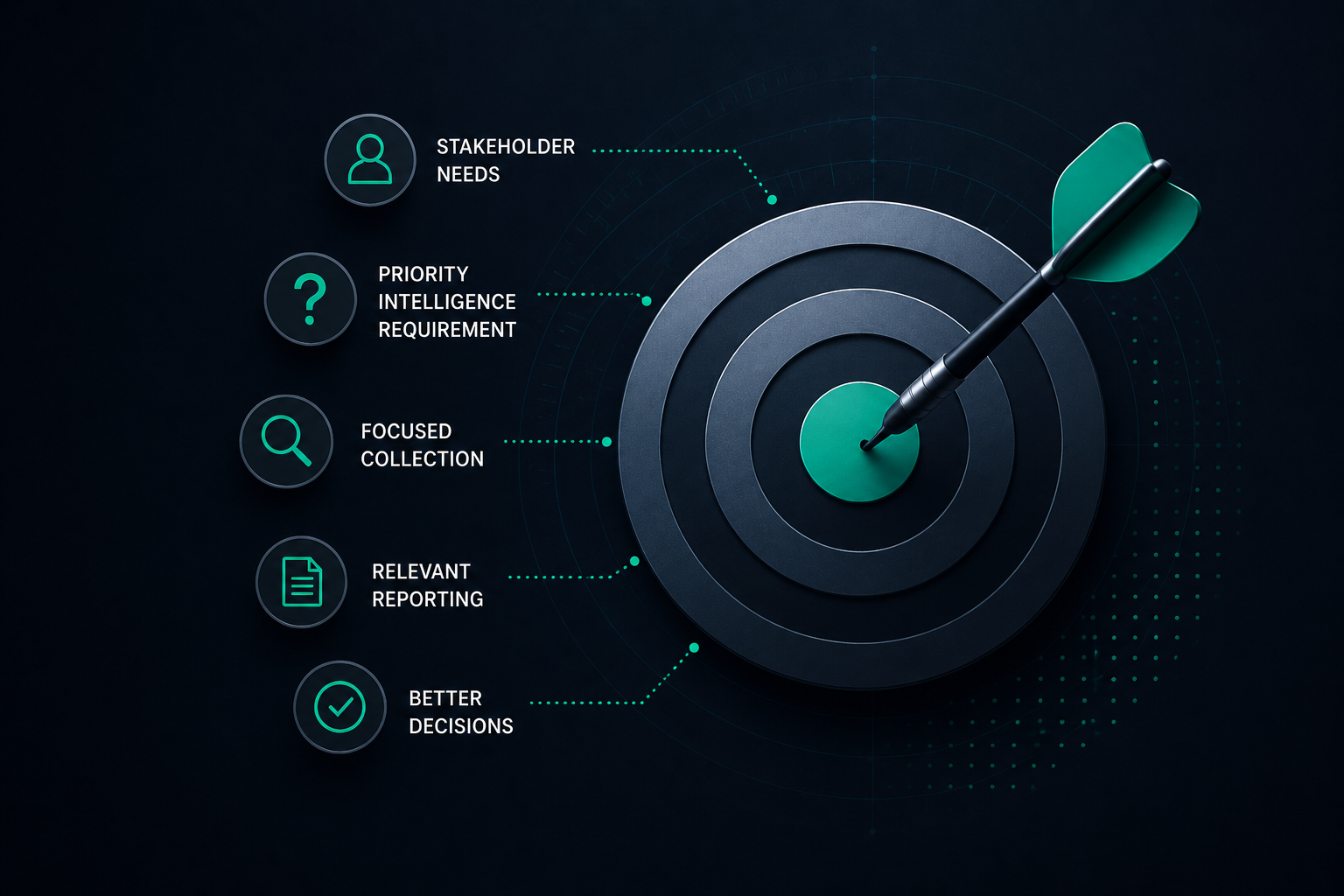
The distinction matters because everything downstream should hang off it. Sources get selected because they help answer a requirement. Alerts get prioritized because they touch a requirement. Reports get written because a requirement asked for them.
PIRs are easy to write and easy to abandon. Most teams produce a list during an annual planning exercise, store it in a wiki, and never look at it again. Day to day, the program reverts to reacting: clearing the alert queue, answering whichever stakeholder was loudest this week, and justifying its value after the fact.
The result is a program that is busy but not directed. Analysts work hard. The work is just not connected to a question anyone is waiting on.
Three things change when requirements become the operating system rather than a document.
Collection becomes accountable. Every source maps to a requirement, and you can measure whether it contributes. Feeds that never support a finding or a report become visible, and defensible to cut.
Triage becomes relevant. Alerts are prioritized against your requirements, not a global severity score. A medium finding on an asset tied to an active PIR outranks a critical that has nothing to do with your mission.
Reporting becomes traceable. Every finished intelligence product links back to the requirement that prompted it and the stakeholder who needed it. That traceability is also the clearest signal of program maturity. A team that can connect a report to a requirement to a decision is operating at a level most never reach.
Threatnote treats intelligence requirements as a first-class object, not a side note. Collection management ties sources to requirements and measures their performance. Alert triage takes your requirements, RFIs, and customer profiles as context and prioritizes accordingly. Finished reports associate back to the RFIs and requirements that drove them, so the link between question and answer is preserved.
The goal is not to collect more. It is to make sure what you collect is answering questions someone actually asked.
If your program had to show, for every source and every report this quarter, which requirement it served, how much would survive the review?