

REQUEST A DEMO
Thank you! Your submission has been received!
Oops! Something went wrong while submitting the form.
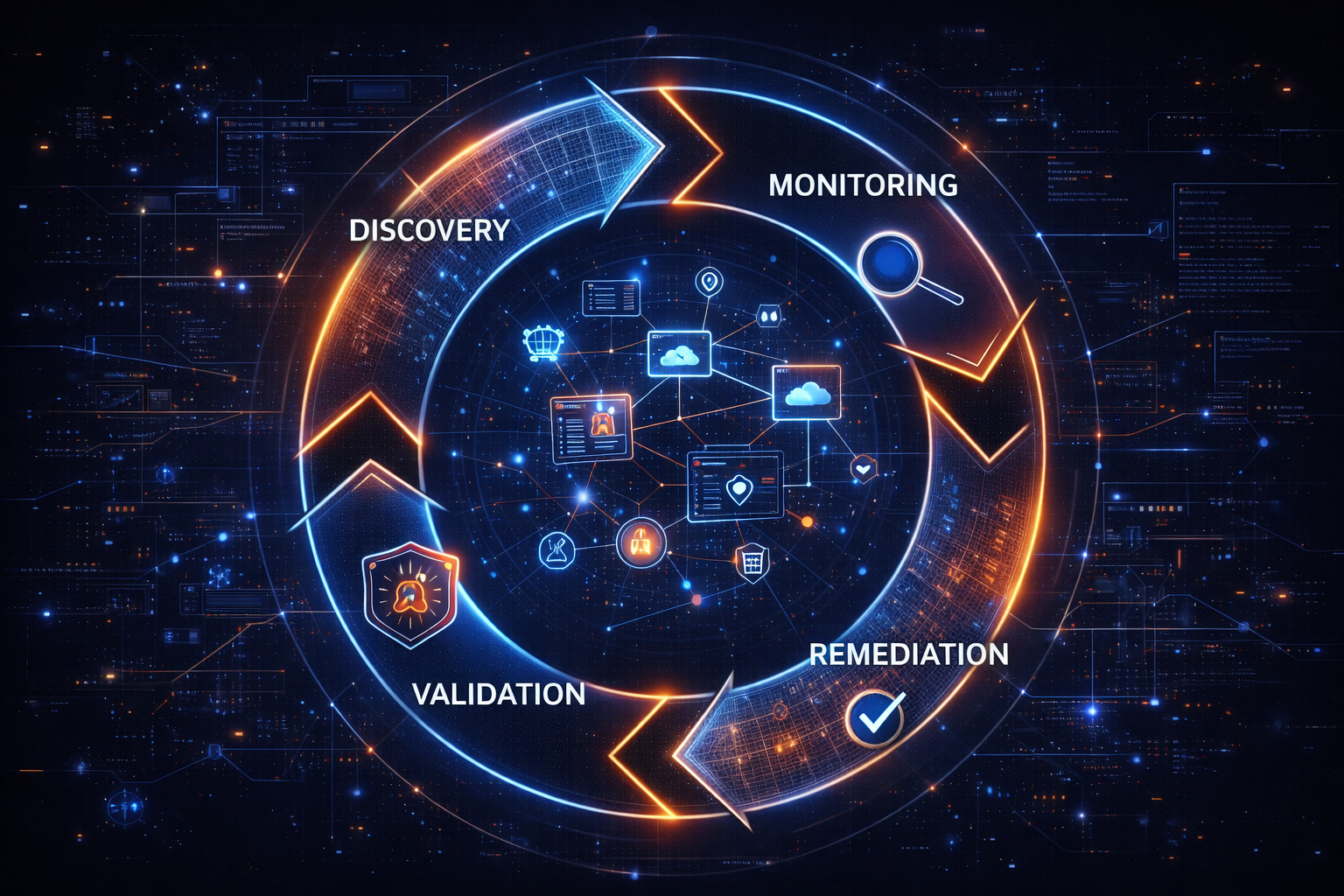
Discovering exposures and connecting intelligence are critical steps, but they still leave an important question unanswered.
Which exposures actually represent real risk?
Many organizations accumulate large volumes of vulnerability data and security findings. However, not every exposure is exploitable in practice. Security teams need a way to continuously validate which exposures could realistically be used by an attacker.
This is the focus of Continuous Threat Exposure Management (CTEM).
Traditional security assessments often rely on point-in-time scans or periodic penetration tests.
While valuable, these approaches can miss changes that occur between assessments.
Infrastructure changes constantly. New services appear, configurations drift, and vulnerabilities are discovered regularly.
CTEM shifts security programs toward a continuous model that focuses on identifying, validating, and prioritizing exposures over time.
Attack surface monitoring plays a key role in this process by continuously identifying externally reachable infrastructure.
One of the most important aspects of exposure management is detecting drift.
As environments evolve, new assets may appear and previously secure systems may become exposed.
Continuous scanning allows organizations to identify changes since the previous scan, including:
By detecting these changes quickly, security teams can investigate exposures before attackers have time to discover them.
Another important component of CTEM is validation.
Security findings often represent theoretical risk rather than practical attack paths.
Through exploit validation and exposure analysis, organizations can determine whether a vulnerability or misconfiguration represents a realistic opportunity for attackers.
This process helps security teams focus on the exposures that matter most rather than attempting to address every theoretical risk equally.
Attack surface monitoring, threat intelligence, and exposure validation are often treated as separate capabilities.
When they operate within a connected intelligence model, they reinforce one another.
Infrastructure discovery reveals what systems are exposed. Threat intelligence provides context about how attackers operate. Exposure validation helps determine which risks are most likely to be exploited.
Together, these capabilities allow organizations to move from reactive security toward proactive risk reduction.
This is the idea behind Intelligence That Works Together.
When visibility, intelligence, and operational workflows are connected, organizations can see risk more clearly and act on it faster.